Every year, the internet turns green and neon. Before the first holiday party even kicks off, a sea of vibrant “Share Cards” starts flooding our Instagram Stories and TikTok FYPs. It’s the one day a year when we all collectively agree to let a streaming app “expose” our listening secrets.
Whether you’re bragging about being in the top 0.05% of Tame Impala listeners or trying to explain why “90s Nostalgia” is your most-played genre, Spotify Wrapped has become more than just a marketing campaign. It’s a global cultural holiday. But how did a simple recap of our own data become the most anticipated event in the music industry? As we look back at the massive success of recent years, it’s clear that Spotify isn’t just selling music—they’re selling us a mirror of ourselves.
Campaign Overview
Let’s start with the basics of how we got here. Spotify Wrapped actually evolved from a 2015 project called “Year in Music.” However, since rebranding to “Wrapped” in 2016, it has exploded in scale every single year.
In the most recent 2025 iteration, Spotify didn’t just tell us what we listened to; they told us how we felt. With over 700 million listeners globally, the campaign reached nearly every corner of the planet. We saw the return of global powerhouses like Bad Bunny and Taylor Swift at the top of the charts, but the real star of the show was the user experience.
The campaign is a massive logistical feat. It requires crunching billions of data points—every skip, every repeat, and every 3 a.m session—and turning them into a sleek, digital yearbook. In 2025, they upped the ante with “Wrapped Clubs” and AI-generated “Listening Archives,” proving that they have mastered the art of making “Big Data” feel incredibly small and personal.
Idea Behind the Campaign
If you think Spotify Wrapped is just about the numbers, you’re missing the magic. At its heart, the idea is all about identity.
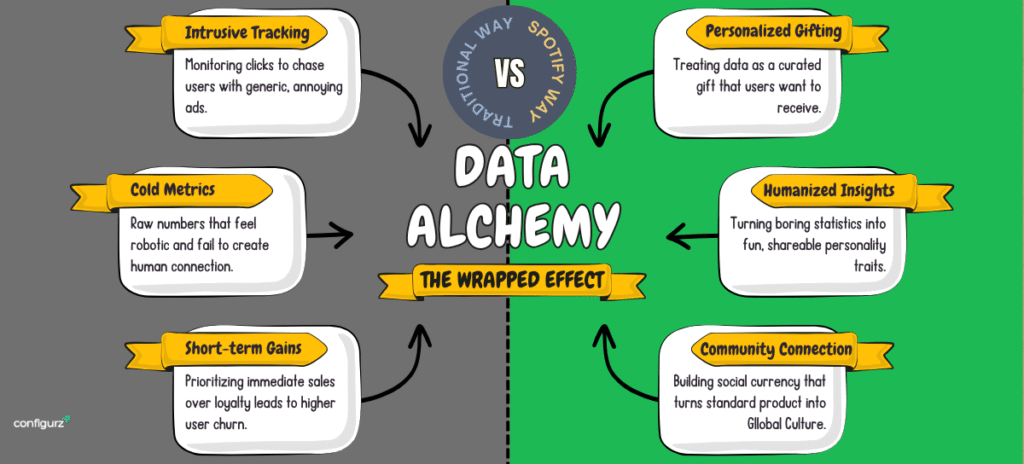
Think about it: most brands collect our data and use it to sell us more stuff. Usually, that feels a bit creepy, right? But Spotify does something brilliant. They take that same data and give it back to us as a gift. They realized early on that people love talking about themselves, but we often feel awkward doing it without a reason.
Spotify provides the “social permission” to talk about our tastes. By framing the data as “Your Audio Aura” or “Your Listening Personality,” they transform cold analytics into something that feels like a horoscope or a personality test. When you share your Wrapped, you aren’t saying, “Look at this app I use.” You’re saying, “This is me. This is my mood. This is how I survived the year.” It’s a masterclass in turning “Big Data” into “Big Emotion.”
How the Message Was Communicated
The genius of Spotify Wrapped lies in how it’s delivered. It’s built from the ground up to be shared. In a world where attention is the most valuable thing we have, Spotify creates content that is “thumb-stopping”.
The Story Format
Spotify was one of the first major apps to adopt the vertical “Story” format for its recap. It feels native to our phones. You don’t have to take a clunky screenshot and crop it; the app provides perfectly designed “Share Cards” with a single tap. The colors are always loud, the fonts are bold, and the animations are snappy.
The Narrative Arc
A Wrapped session isn’t just a list; it’s a story with a beginning, a middle, and a big reveal. In 2025, they even added “Wrapped Parties,” allowing friends to compare their stats in real-time. This turned what used to be a solo experience into a social event.
Artist Connections
Spotify also looped in the creators. In 2025, thousands of artists recorded “Thank You” videos that appeared directly in the Wrapped of their top fans. Imagine being a die-hard fan of an indie artist and getting a personalized video message from them. That creates a level of brand loyalty that money simply can’t buy.
Observed Market
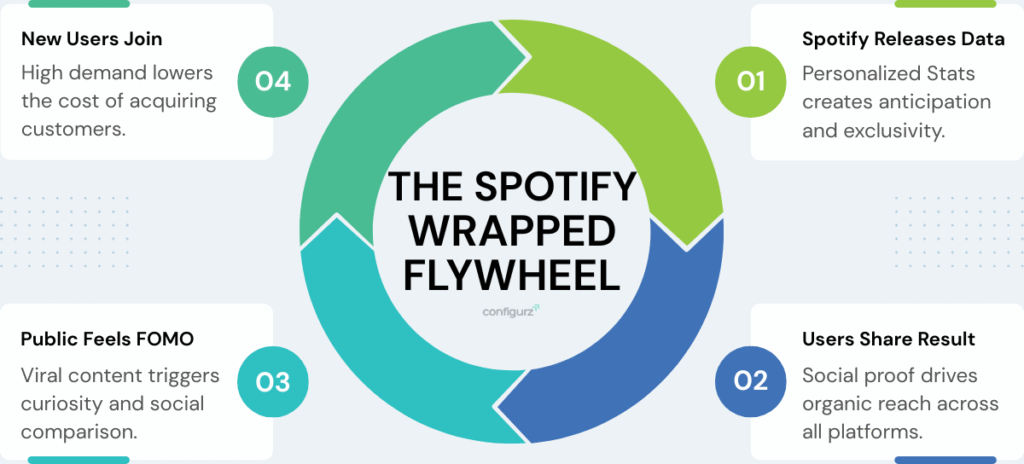
The impact of Spotify Wrapped goes way beyond the app itself. Every December, Spotify consistently climbs to the top of the App Store charts. Why? Because of the FOMO (Fear Of Missing Out).
When everyone on your feed is posting their “Listening Age” or their “Top 5 Clubs,” and you’re an Apple Music or YouTube Music user, you feel left out. While other platforms have tried to create their own versions (like Replay or Recap), they often struggle to match Spotify’s “cool factor.” Spotify has successfully turned its user base into a volunteer marketing army.
Furthermore, Wrapped actually influences the music industry itself. We see “the Wrapped effect” on the charts, where older songs that trended during the year get a second wind as people revisit their top tracks. It’s a self-sustaining cycle of engagement that keeps Spotify at the center of the cultural conversation for weeks. It’s not just a report; it’s a cultural reset that marks the official start of the holiday season for Gen Z and Millennials.
Strategic Principles at Play
So, what’s the “secret sauce” that other brands can steal? If we peel back the curtain, three main strategic pillars make this campaign a recurring win.
1. Zero-Party Data Branding
Spotify takes the data we gave them (our listening habits) and turns it into a “badge of honor.” Instead of using data to target us with annoying ads, they use it to create a personalized product. This builds trust and makes the user feel like the app actually “gets” them.
2. The Power of Scarcity
Wrapped only happens once a year. Because it’s a limited-time event, it creates a sense of urgency. If Spotify gave us these stats every week, we’d stop caring. By making us wait until December, they turn a simple feature into a seasonal ritual.
3. Gamification
In 2025, the “Clubs” feature took things to a new level. By sorting users into groups based on their listening style (like “The Alchemist” or “The Time Traveler”), Spotify tapped into our basic human desire for belonging. It’s not just about what you liked; it’s about finding your tribe.
Learnings for Modern Brands
You don’t need a billion-dollar data budget to learn from Spotify. Whether you’re running a small e-commerce shop or a growing service business, the principles of Wrapped are universal.
Make Customer the Hero
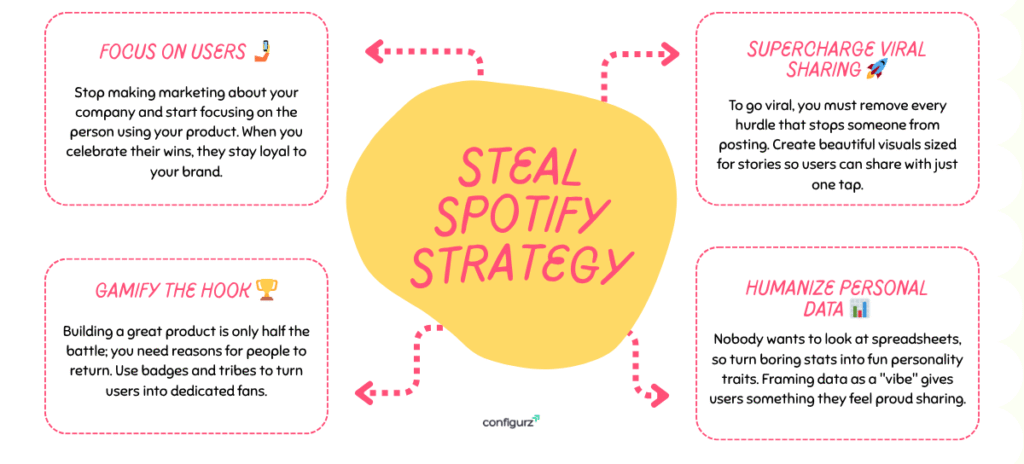
Your marketing shouldn’t be about how great your brand is. It should be about how your customer uses your product to express themselves.
Give Data Back with Value
If you collect customer info, find a way to use it to provide an insight or a “thank you” rather than just a sales pitch.
Design for Shareability
If you want people to talk about you, make it incredibly easy. Create visuals that look good and take zero effort to post.
Embrace Your Brand Voice
Spotify succeeds because they aren’t afraid to be funny, a little snarky, and very human.
At the end of the day, we share these insights because we love seeing brands succeed by being creative. To be totally clear: we didn’t actually run this specific campaign for Spotify—they have a massive team of geniuses for that! However, this is exactly the kind of deep-dive strategy we live for at Configurz. We believe that every brand, no matter the size, has a story hidden in its data. We help our clients find those stories and turn them into campaigns that people actually want to talk about. If you’re ready to move past “boring” marketing and want to create your own version of that “Wrapped magic,” we’d love to help you build it.